
On this page
- What makes a gutter seamless?
- Why do seamless gutters suit Edmonds?
- What size should a seamless gutter be?
- How should a seamless gutter be hung?
- What about corners?
- How much do seamless gutters cost?
- What should a seamless quote say?
- How long do seamless gutters last?
- How is a seamless gutter made on site?
- Are there limits to seamless?
- What does a homeowner notice afterward?
What makes a gutter seamless?
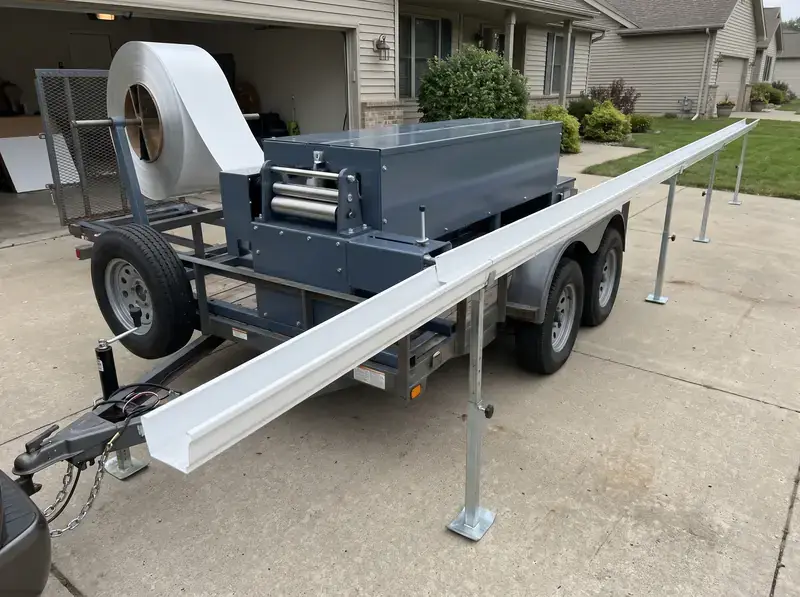
It is made on site. The contractor brings a coil of flat aluminum, steel or copper and a forming machine on the truck. Each eave is measured, and the gutter is rolled to that exact length in one piece. Joints remain only where they must: inside and outside corners, end caps and outlets. Call (425) 215-1852 to be connected with an independent contractor who installs seamless gutters around Edmonds.
| Sectional | Seamless | |
|---|---|---|
| Joints along a run | About one every 10 feet | None |
| Joints in total | Many | Corners, ends and outlets |
| Fit | Cut from stock lengths | Formed to each run |
| Appearance | Visible seams | One continuous line |
| Places for debris to snag | Every seam | Very few |
Why do seamless gutters suit Edmonds?
Because joints and debris are what fail here, not capacity. A seam is a small ledge inside the trough. Needles catch on it, moss grit settles behind it, and water sits against the sealant for weeks through a wet winter. Take the seams away and the gutter drains cleaner and has fewer places to leak. With the city's average of 37.2 inches of precipitation falling mostly between autumn and spring, a gutter here spends a lot of its life wet, so every joint you avoid matters.
What size should a seamless gutter be?
For rain alone, 5-inch is usually enough. At WSDOT's 10-year, five-minute intensity for Everett of about 2.5 inches an hour, the This Old House sizing method gives:
| Seamless gutter | Roof area one run can drain, 6/12 pitch |
|---|---|
| 5-inch K-style | about 2,005 sq ft |
| 6-inch K-style | about 2,895 sq ft |
Six-inch is the better choice where a valley pours into one corner, on steep roofs, and wherever conifers drop needles, because a bigger trough and outlet take longer to block. Many houses mix the two. See 6-inch gutters.
How should a seamless gutter be hung?
On screw-in hidden hangers fixed through the gutter into sound fascia or rafter tails, closely spaced. Spike-and-ferrule fixings, common on 1960s and 1970s houses, loosen as the wood swells and dries through the seasons. Each run should fall steadily toward its outlet so that no water stands in it, which matters doubly here because standing water feeds moss. On long runs, the high point is usually in the middle with outlets at both ends.
What about corners?
They are the weak point of every seamless system. Ask whether corners will be factory-formed or cut on site, and how they will be riveted and sealed. A corner below a roof valley takes water and debris from two planes at once, so it benefits from a larger outlet nearby or a splash guard.
How much do seamless gutters cost?
National price guides put seamless aluminum at about $9 to $14 a foot installed for 5-inch and $11 to $17 for 6-inch, with steel and copper higher. Height, corners, downspouts, removal of the old system, fascia work and discharge all add. See the Edmonds gutter cost guide.
What should a seamless quote say?
| Item | Example |
|---|---|
| Size and profile | 6-inch K-style below valleys, 5-inch elsewhere |
| Metal and thickness | .032-inch aluminum, color named |
| Hangers | Screw-in hidden hangers at a stated spacing |
| Corners | How formed, riveted and sealed |
| Outlets and downspouts | Number, size, position |
| Discharge | Splash blocks, dispersion or tight-lines |
| Removal | Old gutters removed and hauled away |
| Warranty | Workmanship period, in writing |
How long do seamless gutters last?
Well-hung seamless aluminum often lasts 20 years or more. What shortens that around Edmonds is not the metal but what surrounds it: fascia that softens behind overflow, hangers pulling out of wet wood, and corners left to sit in debris. A gutter that is cleaned on schedule and drains dry between rains lasts far longer.
How is a seamless gutter made on site?
The contractor brings a roll-forming machine on a truck or trailer, loaded with a coil of flat, pre-painted metal. Each run is measured, fed through the machine and formed into the gutter profile in one continuous length. The finished length is carried to the house and hung. Very long runs need several people to carry without kinking, and some contractors add an expansion joint on runs long enough to need one.
Are there limits to seamless?
A few. Corners still need joints, mitred and sealed or pre-formed. Very long runs expand and contract with temperature, so the hangers must let the gutter move. And a dented seamless length cannot be patched with a short section as neatly as a sectional gutter; the damaged length is usually replaced. On a sound house those are small trade-offs for losing a joint every ten feet.
What does a homeowner notice afterward?
Fewer drips. Most leaks on older systems come from seams, so a seamless run with sealed corners and outlets is quieter in rain and stays cleaner on the siding below. The outlets, corners and hangers then become the parts to watch.