
On this page
- When is it time to replace?
- Why do so many Edmonds homes need replacement now?
- What does replacement involve?
- What should change in the new system?
- How much does replacement cost?
- Does replacement need a permit?
- Repair or replace?
- How long does replacement take?
- What happens to the old gutters?
- Should gutters be replaced with the roof?
- What about colors and HOAs?
- What should you check when the job is done?
- How do you plan replacement around the seasons?
- Should downspouts be replaced too?
- Does replacement need guards at the same time?
When is it time to replace?
When repairs keep coming back. A few dripping corners on sound gutters are a repair job. Replacement makes sense when faults are everywhere or the system no longer suits the house and its trees. Call (425) 215-1852 and an independent contractor can tell you which applies.
| Sign | What it usually means |
|---|---|
| Leaks at many joints | Sealant and metal have aged out |
| Sags that come back after re-hanging | Fascia failing or metal too thin |
| Rust, splits or holes | Steel near the end of its life |
| Seams every 10 feet or so | Sectional gutters; every joint a future leak |
| Soft, stained fascia along a whole side | Years of overflow behind the gutter |
| Outlets that clog every few weeks | Gutters and outlets too small for the trees |
Why do so many Edmonds homes need replacement now?
Because of when they were built. The city grew from 2,057 people in 1950 to 23,684 in 1970, annexing the hills north and east of downtown as subdivisions went up. Many of those 1950s to 1970s homes are now on their second or third set of gutters, often hung with spikes into fascia that has spent decades getting wet. When the gutters come down, the condition of that wood decides much of the job.
What does replacement involve?
- Take down the old system, including spikes, hangers and downspouts.
- Inspect the fascia, rafter tails and drip edge, and replace soft wood.
- Plan the layout: run sizes, outlet positions, downspout count and size, and discharge.
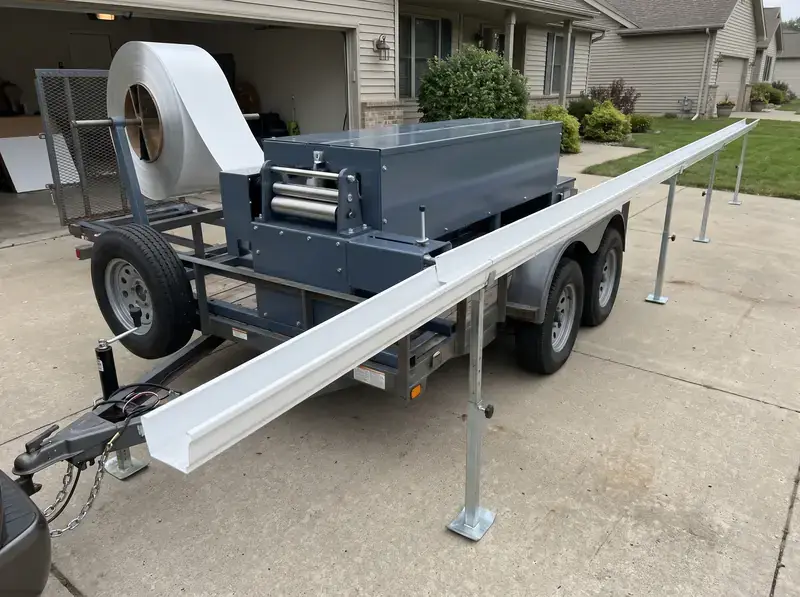
- Form and hang the new runs on screw-in hangers at close spacing.
- Seal corners and ends, cut outlets and fit downspouts.
- Set discharge to suit the lot: splash blocks, dispersion, or tight-lines on slopes.
- Test every run with water before leaving.
What should change in the new system?
- Hangers: screw-in hidden hangers instead of spikes.
- Thickness: .032-inch aluminum on long and exposed runs.
- Outlets: larger outlets where conifers overhang, and runs drained from both ends where long.
- Size: 6-inch below valleys and under heavy debris.
- Discharge: water carried away from crawl space vents and kept off slopes.
- Guards: matched to the trees, fitted at the same time.
How much does replacement cost?
National guides put seamless aluminum at about $9 to $14 a foot for 5-inch and $11 to $17 for 6-inch, installed. Removal, fascia repair, extra downspouts and tight-lines add to that. Ask for a written quote that separates the gutter, the downspouts and any wood repair. See the Edmonds gutter cost guide.
Does replacement need a permit?
A straight swap of gutters on the same house generally does not. New drainage systems, work in mapped critical areas and structural changes at the roof edge can. Edmonds' stormwater code follows the Department of Ecology's 2019 manual, and the city's development services can say whether a change to where water goes needs review.
Repair or replace?
If you are unsure, the repair or replace guide walks through age, metal, the number of faults, the state of the fascia and whether the outlets suit the trees.
How long does replacement take?
Usually a day for a typical house: removing the old system, checking and repairing fascia, then hanging new seamless runs and downspouts. Extensive fascia work, tall eaves or new tight-lines can take longer. Dry weather helps, which is one reason many homeowners book replacement in summer.
What happens to the old gutters?
Most contractors haul them away. Aluminum and steel gutters are widely recycled as scrap metal. Ask whether removal and disposal are included in the price, and whether old downspouts and buried line fittings will be replaced or reused.
Should gutters be replaced with the roof?
Often it makes sense. Roofers frequently remove gutters to replace the drip edge and first course, and fascia is easiest to repair while both are off. Ask both contractors how they will coordinate, who is responsible for the drip edge, and whether the gutter contractor can hang the new system right after the roofer finishes.
What about colors and HOAs?
Factory-finished aluminum comes in many colors. Matching trim is the usual choice; dark colors hide streaks, light colors show moss stains. In neighborhoods with an HOA, such as many in Mill Creek and parts of Mukilteo, check approved colors before ordering.
What should you check when the job is done?
- Every run slopes to an outlet, with no standing water after a hose test.
- Corners and outlets are sealed neatly from inside.
- Hangers are evenly spaced and screwed into sound wood.
- Downspouts are strapped firmly and discharge where agreed.
- The drip edge laps into the gutter.
- Debris and offcuts are cleared from the site.
How do you plan replacement around the seasons?
Book in late spring or summer if you can. Dry weather suits fascia repair and sealant curing, and contractors are less busy before the autumn rush. If the gutters are failing in winter, a contractor can make temporary repairs and schedule replacement for a dry window.
Should downspouts be replaced too?
Usually. Old downspouts are often dented, undersized or attached with failing straps, and new outlets in the new gutter rarely line up with them. Replacing downspouts at the same time costs little extra and gives a matched system.
Does replacement need guards at the same time?
Not necessarily, but under conifers it is the easiest moment to add them.