
On this page
Where do gutters leak?
At joints, almost always. Watch the gutter in a rain or run a hose along it and the drip will usually be at one of these. Call (425) 215-1852 to be connected with an independent contractor who repairs gutter leaks around Edmonds.
| Leak point | Why it fails | Repair |
|---|---|---|
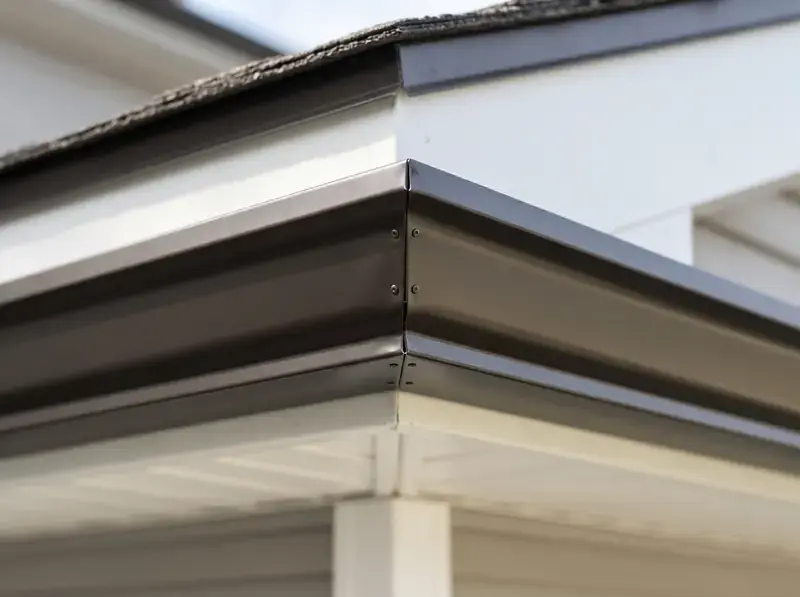
| Inside and outside corners | Sealant ages; miter opens | Strip, clean, rivet, reseal; replace badly bent corners |
| End caps | Sealant lifts; cap loosens | Reseat, rivet and reseal |
| Outlets | Joint between gutter floor and outlet tube fails | Reseal or replace the outlet |
| Seams on sectional gutters | One joint every 10 feet or so | Reseal, or replace with seamless |
| Behind the gutter | Missing or short drip edge | Fit or extend the drip edge |
| Mid-run holes or splits | Dents, limb strikes, corrosion | Patch or replace the length |
Why do joints fail sooner here?
Because they spend so long wet. The city's 37.2 inches of yearly precipitation falls mostly between autumn and spring, and a gutter holding needles or moss grit keeps water against its joints for days after each rain. Sealant that would last for years on a clean, dry joint gives up sooner when it sits wet. Moss, which revives with the rain in early winter, adds grit that settles at the low points, which are usually the corners and outlets.
How is a leak properly repaired?
- Clean the gutter so the joint is visible and water can drain for the test.
- Strip the old sealant completely. New sealant does not bond well over old.
- Clean and dry the metal, which in an Edmonds winter may mean waiting for a dry day.
- Add rivets where a joint relies on sealant alone.
- Apply a gutter sealant suited to the metal, worked in from inside the gutter.
- Let it cure, then test with a hose.
What if water comes from behind the gutter?
Then the joint is not the problem. Water running behind a gutter usually means the drip edge is missing, too short or tucked behind the gutter instead of lapping into it, so water follows the roof deck down the fascia. It can also mean the gutter has pulled forward and left a gap. A contractor can fit or extend the drip edge and pull the gutter tight to the board. Left alone, that water rots the fascia; see fascia and soffit repair.
When does a leak point to a bigger problem?
- Water spills over the front at the same corner. A valley may be pouring into it, or the outlet is blocked. See gutter overflow.
- Water sits in the gutter after rain. The fall is wrong or a hanger has failed. See sagging gutters.
- Many joints leak at once. The system may be near the end of its life. See repair or replace?.
What sealant should be used?
A sealant made for gutters and rated for the metal, applied to clean, dry surfaces from inside the trough. General-purpose caulk and roofing tar crack and lift. Ask what product the contractor uses and how long it needs to cure before rain.
Why fix a small leak quickly?
Because the water goes somewhere every time it rains. A steady drip onto a deck, a step or a walkway stains and rots wood and freezes on cold mornings. A drip at the foundation keeps the same patch of soil wet against the house all winter.
How do you find a leak?
Run a hose slowly into the high end of the gutter and watch underneath, or watch during a steady rain. Mark each drip with tape. Check inside the gutter at that point for a gap, split or failed sealant. Leaks at the ends of runs often come from end caps; leaks at downspouts from the outlet joint.
Can guards cause leaks?
Not directly, but screws through the gutter lip can make small holes if they miss, and a guard can hide a leaking joint. Ask for joints to be resealed before guards go on.